Sunday, 15 March 2015

AC/DC Disconnect

solar AC/DC disconnects by brands like Midnite Solar allow you to isolate the solar inverter from the PV power source. The National Electric Code requires that the AC DC disconnect be in place so that you can stop and start your system should the need arise.

Summary

MidNite Solar breakers are built to provide protection to break the full rated energy load at the rated voltage with no system damage. Always use the appropriate sized breaker for electrical systems to ensure long term system life. MidNite Solar manufactures and develops long lasting breakers for protecting home solar panels or commercial solar panels.
Features:
• MNEPV20
• 150VDC din rail mount breaker
• 20 Amp
• Box size 13mm wide


Summary

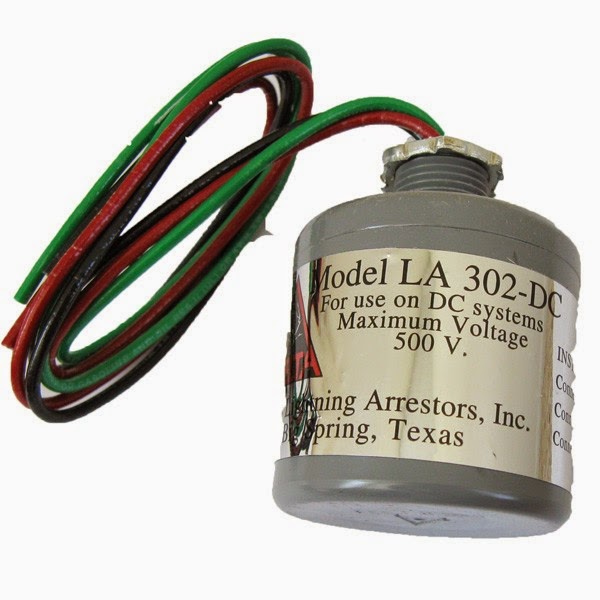
Delta DC Lighting Arrestor LA302-DC for 0-500 Volts DC with waterproof enclosure


Summary
The IO 100 switch box is designed specifically for solar powered SQFlex systems. The IO 100 enables manual starting and stopping of the pump in an SQFlex Solar system and functions as a connection box joining all necessary cables.


Summary


100 amp 150VDC Panel Mount Breaker, 10,000 AIC
UL & CSA Listed
1/4" studs 3/4" wide


Summary

MidNite Solar MNDC225 Mini - DC Disconnect Power Center with 225amp 125VDC Breaker MidNite Solar proudly introduces their latest offering, the MidNite Solar "Mini-DC". Furthering our goal to provide space saving, economical, yet feature packed solutions to the needs of the industry, we bring to the table this new DC Breaker Box.

Description

If you're looking for an affordable, compact DC disconnect, then the Mini DC might be just the ticket. Price includes inverter breaker Din Rail accomodates (5) 125 VDC breakers Shunt and charge contoller mountings Bonded battery / inverter negative tie point Equipment ground bus bar ETL listed for USA and Canada White aluminum enclosure.


Summary

Heavy Duty safety switch disconnects are ideal for heavy industrial and public works applications where reliable performance and service continuity are critical. They include fusible and non-fusible disconnects, available in: 240, 480, 600 Volt AC/250,600 Volt DC; from 30-1200 Amp sizes, and in NEMA 1, 3R, 4, 4x, and 12 enclosures.

Description

General Duty safety switch disconnects are designed for residential, light industrial, and commercial applications, 240 Volt AC only, from 30-600 Amp sizes. These disconnects Include fusible and non-fusible, NEMA 1, (General Indoor) and NEMA 3R (Rainproof), fused or non-fused.
 
  • Stand alone, panel board and bus mounted switches
  • Amperages: 30 to 1200 Amps
  • W or w/o Neutral Ground
  • Indoor NEMA 1 and Outdoor NEMA 3R, 12, 4x


Wednesday, 28 January 2015

Solar Tips

Should you, could you install your own solar electric system?
Over half our customers do install and maintain their own solar power systems. Some hire extra help for part of the installation. Most have an electrician or other professional do the wiring and metering into the house.
So, yes! You can size your system to suit your needs and budget. You can pick the components. And you can install it and maintain it.
There is a team of experienced solar folks here at Wholesale Solar who would love to help you through the process.
Can I build my own solar panels?
You may run into DIY information on the web about building your own solar panels, which we don't really recommend. Leave that to the manufacturers who keep tight control on the safety aspects. But there's lots you can do yourself—from sizing the system, picking components, mounting and installing the solar panels, inverter(s) and safety disconnects. The more you do yourself, the less expensive the whole thing will be.
How big a solar system will I need? 
If you have any questions about sizing your system, we can help. Pull a few of your power bills, then call 1 (800) 472-1142. If you are planning for an off the grid home, look through this load evaluation worksheet before you call.
How much will it cost? 
Cost depends on how much electricity you use. To answer that question we need you to answer 3. and 4. in the righthand column then skip to 8. and 9. Call us when you get in over your head. 1 (800) 472-1142.
Can I self-install a gridtie solar power system?
Many of our gridtie customers do. Gridtie solar is for folks who are already plugged into utility power. Gridtie solar is less complex to install than offgrid and can be easily expanded. Because of utility rebates for gridtie solar systems your installation may be more regulated. Check out the Rules, Regulations and Policies in your state. Plan to have an electrician or licensed contractor do the final hook-up. Would you like us to recommend one in your area? Call our dealer coordinator at 1 (800) 472-1142.
Can I self-install an offgrid solar power system?
Of course you can! Offgrid solar power is for independent minded people who want to live exactly where they want to live! Solar power allows you to buy undeveloped land that you can more easily afford. You're probably building your own home, or at least are very involved in the process. You're the perfect candidate for solar DIY!
We (the founders of Wholesale Solar) started off offgrid in northern New Mexico. We built a house and then figured out how to power it with used solar panels. Those panels came from a museum where they were installed during the Jimmy Carter administration (1977 - 1981) and are producing electricity still.
We also powered a 1,000 foot deep well with solar panels, despite several well pump installers telling us it couldn't be done!

Monday, 24 November 2014

What the Future of Solar Panels


 Over the past decade, there's been a lot of change in the solar panel industry. Costs have come down dramatically, silicon panels have held off a slew of competing technologies, and most importantly, the market has become financially viable.

This is great progress, but there's a relentless need for the solar industry to cut costs, and that means companies are far from done innovating when it comes to solar panels. The next leap forward is already under way.

More and more communities, like this one, are finding it cost effective to go solar. Source: Sun-
Power.


The next phase of solar panels 
The technology solar manufacturers have added to solar systems in just the last few years is remarkable. When you get solar installed on your home, it's no longer just panels and a meter that spins both forward and backward for net metering with the grid (I'm simplifying, here). Today, a solar system can tell you if there's a problem and where it is, energy can be stored and used at a later time, and in the future, the solar system will even be at the heart of your home's energy management.
One step along that path is integrating more electronics into the solar panels themselves. This will allow manufacturers to move more component assembly from the field to highly efficient manufacturing plants and reduce the number of components shipped to a site. There's huge progress being made on that front right now.
En-phase Energy has been one of the leaders in what's called micro inverters, small inverters that are installed on the solar panel itself as opposed to a larger string inverter for the entire solar system. The micro inverter means electricity coming from the solar panel will be alternating current (AC), which your house runs on, instead of direct current (DC). This should allow for easier installation and fewer components for installers to manage.

Sun power -recently bought micro  Inverter manufacturer Solar Bridge Technologies to add capabilities to its high efficiency solar panels. Last week, management explained how the micro inverter technology will help simplify the residential installation process.

Here's an image of the components Sun-power uses today:


Source: Sun Power.

And this is an image of the residential solar system of the not so distant future. You can see that this will reduce inventory, complexity, and labor costs for each solar installation.


Source: Sun Power.
An increasing amount of technology is being put into the solar panel itself, which will help lower costs and installation times.
Just the beginning of panel innovation 
Most of the integration of the solar panel and inverter is currently happening at the installation level, but in the future, solar panel manufacturers will integrate inverters into the panels themselves.
Solar City is building a manufacturing plant with technology acquired from Silevo. Given the company's focus on cutting costs and reducing installation steps I would be surprised if they didn't acquire micro inverter technology in the near future and add that component to manufacturing plans. Green tech-media recently predicted that Solar Edge Technologies would be its target and I also think En-phase Energy would make a lot of sense.
The other company who could benefit from a more seamless system is Vivint Solar , who uses En-phase Energy micro inverters but uses a variety of solar panel manufacturers. If all panels came pre-assembled it would ease the installation process even further.
Another advantage of micro inverters is the ability to monitor a solar system on a panel specific level. As it stands today, centralized string inverters can monitor a system's performance but it's harder to tell you which panel is having issues or what's going wrong. Panel level electronics could do that.
The future of solar panels 
Micro inverters are a growing percentage of residential solar systems and in a few years I think they'll dominate the market. This will lower installation cost, reduce installation time, and improve operational functionality for solar consumers.
The vision is that solar panels of the future will be almost a plug and play proposition for homeowners, reducing the complexity of installing solar and making it cheaper to be a solar energy producer. That's good for the growth of the solar industry and opens a new markets to cost effective solar energy.
1 great stock to buy for 2015 and beyond 2015 is shaping up to be another great year for stocks. But if you want to make sure that 2015 is your best investing year ever, you need to know where to start. That's why The Motley Fool's chief investment officer just published a brand-new research report that reveals his top stock for the year ahead. To get the full story on this year's stock

Saturday, 25 October 2014

Getting Started with Solar Electricity

Getting Started with Solar Electricity

With grid-tied PV systems becoming more and more popular, it is important for RE professionals and system owners alike to have realistic expectations of their systems’ performance. Solar-electric power production can be affected by several factors. Orientation, array tilt, seasonal adjustments, and array siting can all affect the bottom line. Proper planning and smart design will help you get the most out of your PV system and improve your rate of return. Installing modules in a sunny, shade-free spot and pointing them toward the sun could be considered common sense to many, but properly orienting and tilting your array for optimal performance is not as intuitive. A PV array’s output is proportional to the direct sunlight it receives. Even though PV modules produce some energy in a shady location or without ideal orientation, system costs are high enough that most will want to maximize energy yield. Regardless of how well a system is designed, improper installation can result in poor performance. PV systems should operate for decades, and the materials and methods to install them should be selected accordingly.
Should you install your system or hire a licensed professional to do the work? What skills and tools do you need to tackle a home-scale PV project? How much will you save if you install the system yourself? We frequently get questions like these from Home Power readers. Rather than defaulting to the obvious answer, “it depends,” we explore a long list of variables you should thoughtfully consider before tackling the design and installation of your PV system. Owner installation is definitely not for everyone. Like any home improvement project, it’s important to realistically assess your skills, and weigh the benefits and potential pitfalls. Installing a PV system certainly isn’t rocket science, but doing it well and safely requires experience working with electrical systems, some serious research, and plenty of sound advice. The installation of most residential PV systems is usually better left to the pros, but if you have the right set of skills and expectations, installing your own system can be a realistic goal.
Often, folks who want to install their own system are the same people who are pondering a career shift into the PV industry.  Despite the challenging economic climate, there are jobs to be had in this growing market, and with government funds and decreasing component costs fueling new projects and green job training, the time is right to make your move. With a little know-how, the right training, and a sunny disposition, you can be on a new, green career path. Depending on your background and existing skill set, attending a workshop or two may get your foot in the door with a solar company, but you’ll likely need to pursue some level of certification or additional credentials if you’re serious about making a career in the industry. While you can obtain a lot of system design knowledge from online and classroom presentations, when it comes to installation specifics, nothing beats hands-on training. These courses are not short—nor inexpensive—and are usually geared toward individuals wanting to become professional installers. Training followed by a home installation can be a great progression if you’re considering entering the PV industry. The value of living with a PV system, for both homeowners and up-and-coming professionals, is priceless.

How to Implement Solar Electricity

How to Implement Solar Electricity?
As discussed in Step 1, there are several different applications for PV systems. Which system is right for you depends on your particular situation and RE goals. Due to available incentive programs and the simplistic nature of batteryless grid-tied PV systems, they are the most common type of system installed in the United States today. Here is a checklist to see if this type of system might work for you:
  • Interested in clean power? Check.
  • Already on the grid? Check.
  • Infrequent utility outages? Check.
  • Have a sunny location to mount PV modules? Check.
If this describes your situation, then a batteryless grid-tied PV system could be the perfect fit. Compared to their off-grid counterparts, batteryless grid- tied systems are simple to understand and design, with only two primary components: PV modules and an inverter that feeds AC electricity back into the electrical system to offset some or all of the electricity otherwise purchased from the utility. These systems are cheaper, easier to install and maintain, and operate more efficiently than battery-based systems of comparable size. Their main drawback is that when the grid goes down, they cannot provide any energy for you to use. If the grid in your area is mostly reliable and outages are infrequent, these systems can offer the best payback for the least price.
The primary goal of a grid-tied PV system is to offset all or some of your electricity usage. Yet the first step in going solar is not sizing the PV system, but reducing electricity usage through conservation and efficiency measures. Once energy-efficiency and conservation measures have been implemented, you’re ready to size a PV system to offset the remaining energy usage. Annual energy use figures can be requested from your utility, and these values can be used to determine the PV array size. However, there are a few other considerations that will impact PV system size. In residential areas especially, a primary constraint to PV array sizing can be the size of the available shade-free mounting area. PV modules can be mounted on a roof, the ground, or a pole (which includes trackers). Regardless of which mounting method is used, the shade-free area, minus clearance needed for maintenance or roof setbacks required by local fire department guidelines, will limit how large the array can be. In the case of roof-mounted systems, typically 50% to 80% of a roof plane will be available for mounting PV modules. Often the most confining consideration is budget. Currently (early 2012), the cost per installed watt of residential PV systems ranges from $5 to $8, which includes everything—modules, inverter, disconnects, racking, wire, and conduit to taxes, shipping, installation labor, and permitting. Reducing the cost is the uncapped 30% federal tax credit. Additionally, many individual states, municipalities, and utilities offer rebates that can further offset a PV system’s cost. The Database of State Incentives for Renewables & Efficiency (DSIRE; www.dsireusa.org) organizes incentive programs by state and program type, making incentives easy to research.
Off-Grid Systems: Living off the grid is a romantic ambition for some; a practical necessity for others. But whatever your motivation for off-grid living, cutting the electrical umbilical cord from the utility shouldn’t be taken lightly. Before you pull out the calculator, size up the realities and challenges of living off the grid. Designing a stand-alone PV system differs substantially from designing a batteryless grid-direct system. Instead of meeting the home’s annual demand, a stand-alone system must be able to meet energy requirements every dayof the year. Determining the home’s daily and seasonal energy usage, along with considering the daily and seasonal availability of the sun, allows designers to estimate the PV array and battery bank size, and charge controller and inverter specifications. 


Why Use Solar Electricity?

Why Use Solar Electricity?

When we consider the true cost of energy, we need to look at the big picture, not just the rate on the utility bill. Conventional fuels have real social, environmental, and economic impacts. There are annual and cumulative costs that stem from all of the pollutants (airborne, solid, and liquid) emitted from mining, processing, and transporting fossil fuels that impact our public health and the environment. Electricity derived from coal and natural gas will never be able to outweigh the energy and continual resources required to produce it. Unlike conventional energy sources, PV systems produce clean electricity for decades after achieving their energy payback in three or fewer years—this is truly the magic of PV technology.

 Grid electricity is paid for as you use it, with payments stretching out forever. In contrast, the majority of PV system expenses are paid for at the time the system is installed. After that, the energy is essentially free. In strictly economic terms, the rate of return for your PV system depends on three things—solar resource; electricity prices; and state policies or incentives. While many utilities sell electricity at affordable rates, inflation as well as energy price history and forecasts indicate price increases in our future, which will make RE systems’ payback even quicker. Historical data reported by the Edison Electric Institute shows that from 1929 to 2005, the average annual price increase for electricity has been 2.94% per year. And according to the Energy Information Administration’s June 2008 Short Term Energy Outlook, utility rates are projected to increase by an average of 3.7% in 2008 and by another 3.6% in 2009. Federal tax credits for renewable energy systems are available, reducing a RE system’s cost, and many states, regions, and utilities also offer substantial rebates, performance-based incentives, tax credits, tax exemptions, loans, and other economic incentives for solar-electric systems.
Independence is chief among the reasons for wanting an off-grid PV system where the grid is available. Off-grid systems are not subject to the terms or policies of the local utility, nor are system owners subjected to rate increases, blackouts, or brownouts. If you’re shopping for rural property, you’ll probably find that off-grid parcels are less expensive. Being off-grid can also be cheaper than getting a utility line extended to a property.
When weighing the energy options (between the grid and solar, wind or water sources) it becomes apparent that solar energy is a very democratic form of energy. Because the sun shines everywhere, the potential to utilize solar energy is available to everyone. Additionally, as compared to generators (gas, or even wind- or hydro-powered ones), because PV systems have no moving parts, they are extremely reliable and require very little maintenance.

What is Solar Electricity

What is Solar Electricity?

Photovoltaic (PV) modules make electricity from sunlight, and are marvelously simple, effective, and durable. They sit in the sun and, with no moving parts, can run your appliances, charge your batteries, or make energy for the utility grid.
A PV array is the energy collector—the solar “generator” and does so via the photovoltaic effect. Discovered in 1839 by French physicist Alexandre-Edmund Becquerel, the photovoltaic effect describes the way in which PV cells create electricity from the energy residing in photons of sunlight. When sunlight hits a PV cell, the cell absorbs some of the photons and the photons’ energy is transferred to an electron in the semiconductor material. With the energy from the photon, the electron can escape its usual position in the semiconductor atom to become part of the current in an electrical circuit.

 Most PV cells fall into one of two basic categories: crystalline silicon or thin-film. Crystalline silicon modules can be fashioned from either monocrystalline, multicrystalline, or ribbon silicon. Thin-film is a term encompassing a range of different technologies, including amorphous silicon, and a host of variations using other semiconductors like cadmium telluride or CIGS (copper indium gallium diselenide). Thin-film technology generates a lot of the current R&D chatter, but crystalline modules currently capture more than 80% of the marketplace.
To use the energy from the array, you may also need other components, such as inverters, charge controllers and batteries, which make up a solar-electric system. The components required are dependent on the system type designed. System types include:
PV-DIRECT SYSTEMS: These are the simplest of solar-electric systems, with the fewest components (basically the PV array and the load). Because they don’t have batteries and are not hooked up to the utility, they only power the loads when the sun is shining. This means that they are only appropriate for a few select applications, notably water pumping and ventilation—when the sun shines, the fan or pump runs.
OFF-GRID SYSTEMS: Although they are most common in remote locations without utility service, off-grid solar-electric systems can work anywhere. These systems operate independently from the grid to provide all of a household’s electricity. These systems require a battery bank to store the solar electricity for use during nighttime or cloudy weather, a charge controller to protect the battery bank from overcharge, an inverter to convert the DC PV array power to AC for use with AC household appliances, and all the required disconnects, monitoring, and associated electrical safety gear.
GRID-TIED SYSTEMS WITH BATTERY BACKUP: This type is very similar to an off-grid system in design and components, but adds the utility grid, which reduces the need for the system to provide all the energy all the time.
BATTERYLESS GRID-TIED SYSTEMS: These most common PV systems are also known as on-grid, grid-tied, utility-interactive, grid-intertied, or grid-direct. They generate solar electricity and route it to the loads and to the electric utility grid, offsetting a home’s or business’s electricity usage. System components are simply comprised of the PV array, inverter(s), and required electrical safety gear (i.e., fuses/breakers/disconnects/monitoring). Living with a grid-connected solar-electric system is no different than living with utility electricity, except that some or all of the electricity you use comes from the sun. (The drawback of these batteryless systems is that they provide no outage protection—when the utility grid fails, these systems cannot operate.)